You read labels on your food. You know what parabens are doing in your skincare. You’ve switched to a cleaner shampoo.
But you’ve probably never turned your perfume bottle around and asked: what’s actually in this?
Most people haven’t. And that’s exactly what the fragrance industry — particularly the mass-market end — has been counting on.
Let’s have the conversation.
What’s Typically Hiding in a Mass-Market Perfume
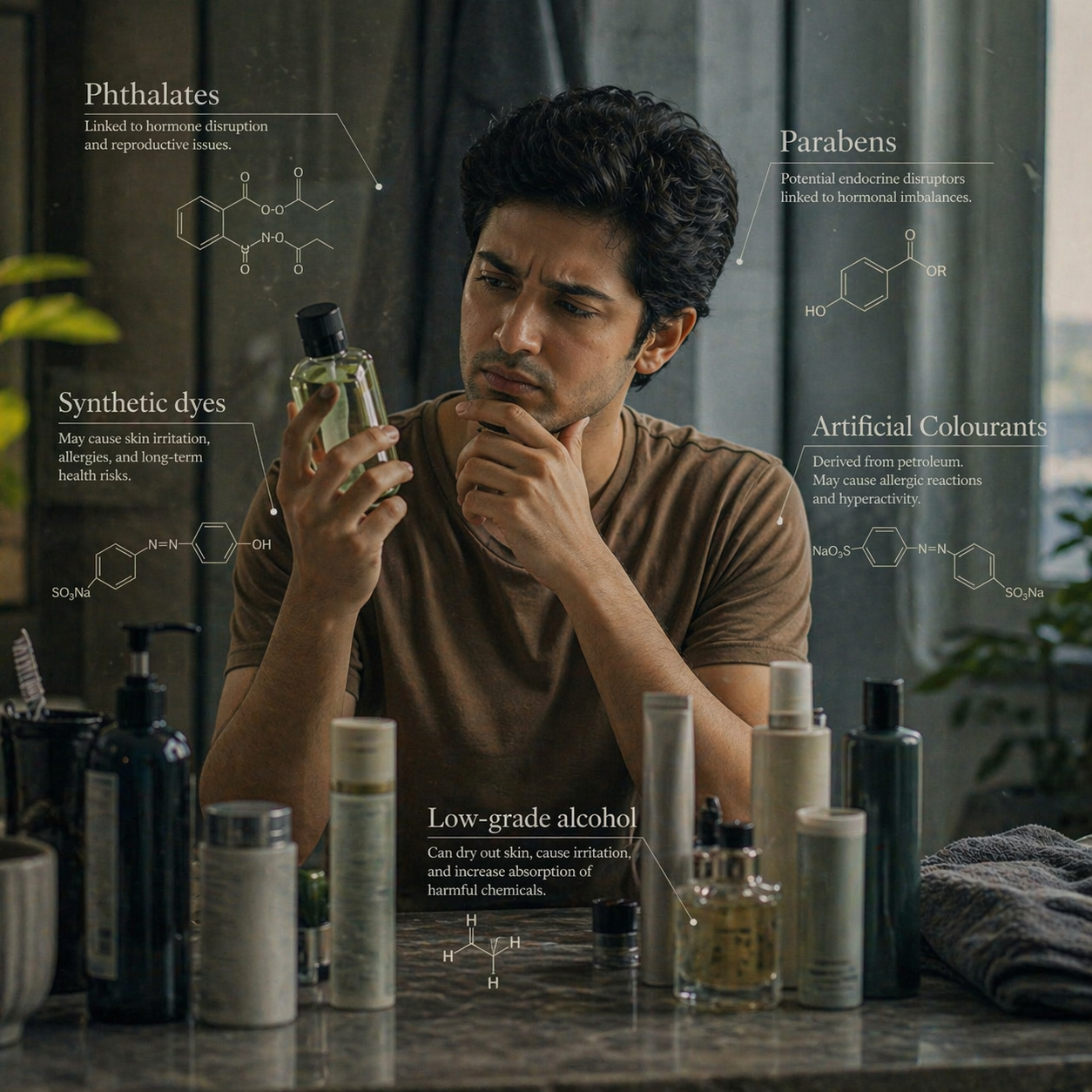
Phthalates are plasticising chemicals used in many fragrances to help the scent last longer. They’re classified as endocrine disruptors — meaning they interfere with the body’s hormonal systems. The EU has restricted several phthalates in cosmetics. India has no equivalent restriction yet. So they’re still widely used here.
Parabens are preservatives — methylparaben, ethylparaben, butylparaben. They’ve been under scrutiny for potential hormonal disruption for years. Many global brands have quietly removed them. Many Indian brands haven’t.
Synthetic dyes and artificial colourants add zero fragrance value. They exist purely so the liquid looks prettier in the bottle. But dyes applied to skin every day are an unnecessary chemical load with no upside.
Low-grade alcohol — not all ethanol is equal. Some mass-market perfumes use industrial-grade ethanol with a strong inherent odour that the formula has to fight against. Higher-quality brands use pharmaceutical-grade or sugarcane-derived alcohol, which is odourless and far gentler on skin.
What “Clean Fragrance” Actually Means
When used responsibly, clean fragrance means: no phthalates, no parabens, no artificial dyes, no known carcinogens, IFRA compliance (internationally recognised safety standards for fragrance ingredients), and transparency — the brand can tell you what’s in the bottle.
The last point is the most underrated. Fragrance has historically hidden behind “trade secret” exemptions to avoid disclosing ingredients. Genuinely clean brands don’t have anything to hide — and they’ll show you.
Why This Matters More Than You Think
You apply perfume to your skin — your largest organ — every single day.
A few sprays doesn’t sound like much. But daily application, over months and years, of synthetic chemicals that have even minor hormonal or carcinogenic potential adds up. The personal care industry calls this cumulative exposure.
There’s also the skin sensitivity question. If you’ve ever had a reaction to a fragrance — a rash, a redness, an itch — it was almost certainly a reaction to a synthetic chemical in the formula, not the fragrance itself. IFRA-certified, paraben-free formulas dramatically reduce this risk.
And then there’s the environment. Phthalates wash off into waterways. They’re consistently found in environmental samples worldwide. Choosing a clean fragrance is a small but real act in the right direction.
How to Read a Perfume Ingredient List in 60 Seconds
Most perfume boxes include an ingredient list — printed in tiny font on the bottom flap that nobody reads. Here’s what to look for:
Red flags: - Any word ending in “paraben” — methylparaben, ethylparaben, butylparaben - Diethyl phthalate (DEP) — the most common phthalate in fragrance - CI + number codes — these are artificial dyes, entirely unnecessary
Green flags: - “Sugarcane-derived alcohol” or “pharmaceutical-grade ethanol” - “IFRA compliant” or “IFRA certified” - Explicit “paraben-free, phthalate-free” statement — clear, not vague
Why Clean Matters Even More When You Travel
When you’re travelling — long flights, climate shifts, unfamiliar humidity — your skin is already under stress. It’s adjusting and reacting to everything new.
This is the worst time to add a chemically complex fragrance to the equation. Clean fragrances with skin-compatible ingredients won’t worsen travel-related sensitivity. They’re gentler in flight, where recirculated air makes synthetic chemicals more potent and noticeable. And they perform more consistently across climate changes.
Frequent travellers consistently report that clean fragrances feel more comfortable across long journeys — something you notice most in the dry, pressurised environment of a cabin.
The Short Answer on What to Buy
There are genuinely very few Indian fragrance brands that currently tick all the clean boxes at a mid-premium price point.
The checklist: paraben-free + phthalate-free + IFRA compliant + transparent about alcohol source + no artificial dyes.
"The Bombay Lab meets every one of these — and publishes its commitment to them, because the belief here is that you deserve to know exactly what you’re wearing."
Not as a marketing angle. As a baseline.
"The Bombay Lab: Paraben-free. Phthalate-free. No silicones, no sulphates, no artificial dyes. IFRA-compliant. Made with high-grade sugarcane-derived ethanol. Clean — by choice, not by trend."