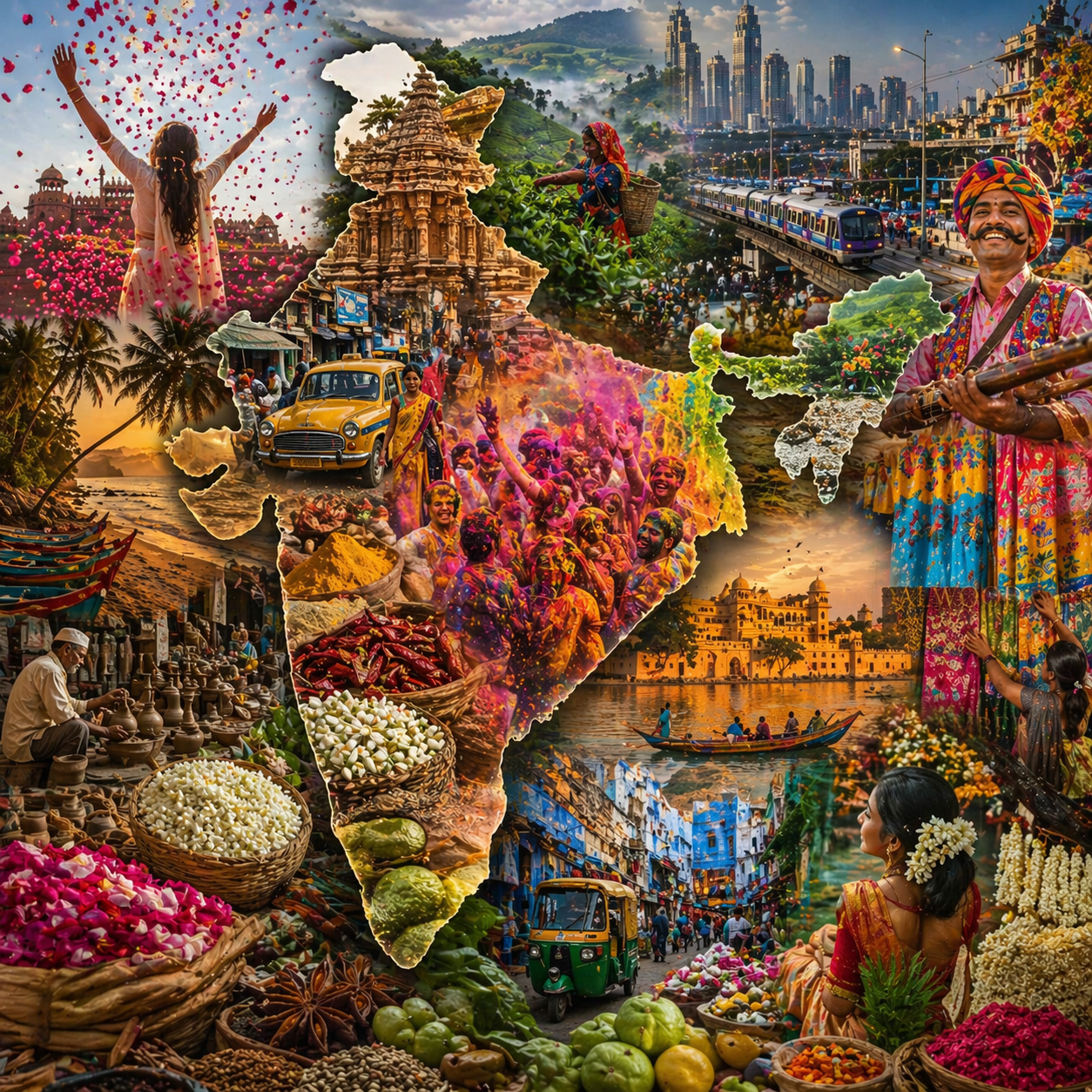
Think of the last place in India that completely undid you. The place that made you forget, even briefly, the noise of your ordinary life.
Where was it?
The cold air of a Manali morning, so clean it almost tastes like water? The ancient smell of the Ganga at first light — incense, marigold, river mist? The languid Sunday ease of Bandra — coffee and salt air and the feeling of nowhere to be?
Whatever it was, you remember the smell.
You always remember the smell.
Why Scent Is the Truest Souvenir
Photographs capture light. Words capture meaning. But smell captures something that neither can reach.
The olfactory nerve is the only sensory pathway that connects directly to the brain’s limbic system — the seat of emotion and memory — without a relay station. Sight, sound, touch, taste: all filtered. Smell: direct. Immediate.
This is why a particular fragrance can return you to a moment with more precision than any photograph. It doesn’t just remind you — it reinhabits you. For a moment, you are there again.
Great perfumers have always known this. The best fragrances aren’t about smelling good. They’re about feeling something true.
"This is the entire premise behind The Bombay Lab’s first collection —. Not a postcard version of India. The real one. The version that people who have actually been to these places carry somewhere behind their breastbone for years."
Old Manali Lanes — Mountain Air at First Light
Manali at dawn is one of India’s most quietly spectacular experiences.
Before the tourists. Before the chai stalls open. Before the horns start. There’s a window — maybe forty minutes — when the lanes are cold and silent and the pine trees are releasing the night’s damp into the morning air. The light is grey-gold. Your breath shows. Everything smells clean in a way that cities have entirely forgotten.
Old Manali Lanes was built for that exact moment.
Opening notes carry the fresh, resinous sharpness of pine. The heart softens into something warmer — cedar, a trace of woodsmoke, the faint earthiness of mountain stone. The dry-down is unhurried and deep. It stays close to the skin, like the memory of cold air even after you’ve come inside.
This is the smell of altitude. The smell of waking up somewhere that matters.
Echoes of Ganga — The Soft Thunder of the River
No place in India carries more olfactory complexity than the Ganga at Varanasi.
Incense — thick, ancient, from a hundred sources at once. River mist, mineral and cold before sunrise, warming into something heavier as the day turns. Marigold. Sandalwood. The earthy sweetness of wet stone steps. And underneath all of it, a sense of time that’s much larger than you.
Echoes of Ganga finds the emotional core of it — the feeling of standing next to something ancient and continuous.
Resinous, quietly smoky, with a sandalwood heart that deepens over hours. On a cold morning, it carries the exact quality of a Ganga ghat at dawn: contemplative, unhurried, and strangely comforting.
Sundays in Bandra — Languid, Caffeinated, Salt-Air Soft
Bandra is the only neighbourhood in India that has made leisure into an aesthetic.
Specifically: Sunday morning Bandra. The light is doing something beautiful on the lane outside the café. You’re on your second coffee with no plans. The sea is two kilometres away but you can smell it. Old stone, warm bread from somewhere, the particular ease of a city that’s decided to rest.
Sundays in Bandra opens warm and slightly caffeinated — there’s a roasted quality to the top notes that recalls exactly the right kind of café. The heart is soft floral, like sunlight through muslin curtains. The base is warm musk over something woody — the smell of an old building in good light.
The feeling is ease. That’s the hardest thing to bottle.
Winds of Ladakh — Vast, Cold, Unmistakably Free
Ladakh doesn’t smell like anything else in India.
At 3,500 metres, the air is so thin and dry that it carries almost nothing. And somehow that absence — the complete lack of urban smell, agricultural density, human noise — becomes its own sensation. The wind carries distance. You smell rock and sky and the thin cold of somewhere very far from everything.
Winds of Ladakh is the most austere fragrance in the collection. Clean. Open. Woody without being heavy.
This is the fragrance for the person who’s stood at the edge of Pangong Tso at sunrise thinking: I am very small, and the world is very large, and that is exactly right.
Letters from Pondicherry — French Walls, Indian Heart
Pondicherry is the only city in India that smells like nostalgia for somewhere you’ve never been.
The French Quarter’s pastel walls carry the quality of old stone in coastal air. Bougainvillea everywhere. The sea never far. The food warm and aromatic. And threading through all of it, a calm that comes from a city that never forgot how to be beautiful.
Letters from Pondicherry is the most romantic fragrance in the collection.
Floral heart, warm amber base, something slightly powdery in the dry-down that recalls slow afternoons and handwritten letters. It’s the fragrance of a different pace. Of somewhere that still believes beauty is worth the effort.
Malabar Mornings — Spice and Salt and Green
Kerala’s Malabar coast has been a destination for fragrance for 3,000 years. Long before anyone was making perfume, people were sailing to this coastline for pepper, cardamom, clove.
Malabar Mornings honours this history while wearing it lightly. Opening spice — pepper, green cardamom — over a heart of coastal floral and something warmly resinous. The base is clean and woody, like cinnamon wood drying in morning sun.
It’s the fragrance for the person who wakes up early in a houseboat on the backwaters, climbs to the roof before anyone else, and watches the mist lift off the green water while the world is still deciding to begin.
Why This Collection Exists
India’s places deserve perfumes made by someone who has actually been there. Not someone who read about them. Not a focus group’s version of what India should smell like.
Every fragrance in our collection was built from memory — from the specific, indelible experience of being in these places. That’s the only way to make a fragrance that feels true.
When you spray one of these and something inside you recognises it — even if you’ve never consciously smelled that exact combination before — that’s not accident.
That’s craft. That’s what it means to bottle a place.
"The Bombay Lab’s Collection: Old Manali Lanes, Echoes of Ganga, Sundays in Bandra, Winds of Ladakh, Letters from Pondicherry, Malabar Mornings. Each 50ml. Each ₹2499."